-
WhatsAPP: +86 18706448138
-
Tengzhou, Shandong, China

Innovative Electrical Solutions for CNC Machines
Innovative Electrical Solutions for CNC Machines

How to Choose the Right CNC Machine Control Panel for Your Machine
Checklist
CNC Machine Control Panel Selection Checklist
- Is the panel fully compatible with your CNC system?
- Are the button technologies suitable for your operating environment?
- Will the graphics remain readable after years of use?
- Can the panel layout be customized for your machine?
- Does the supplier offer long-term OEM production support?
When evaluating a CNC machine, buyers often pay close attention to spindle speed, positioning accuracy, and the CNC controller itself. These are undoubtedly the core components that determine machining performance.
However, there is another component that operators interact with hundreds of times every day, yet it is frequently overlooked during machine development—the CNC machine control panel.
A poorly designed control panel doesn’t reduce spindle speed or machining accuracy, but it can slow down operation, increase the risk of human error, shorten component life, and ultimately affect how customers perceive the quality of the entire machine.
For machine builders, choosing the right control panel is not simply selecting a panel that fits the installation dimensions. It is a design decision that influences usability, reliability, maintenance, and even brand image.
So, what should be considered when selecting a CNC machine control panel?
1. Compatibility Comes Before Appearance
One of the most common mistakes is selecting a panel based primarily on its appearance or dimensions.
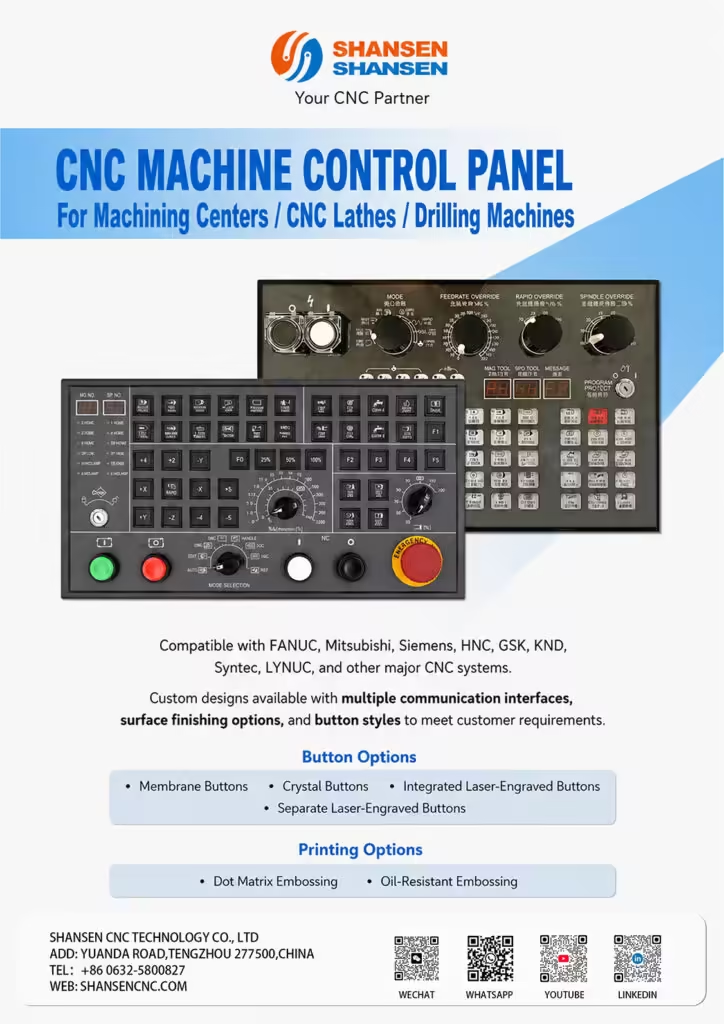
In reality, the control panel must first match the CNC system being used. Different controllers have different requirements for key layouts, communication interfaces, indicator arrangements, and operational logic.
Whether your machine is equipped with FANUC, Mitsubishi, Siemens, HNC, GSK, KND, Syntec, LYNUC, or another CNC platform, compatibility should always be the first checkpoint.
A well-matched control panel simplifies system integration, shortens commissioning time, and reduces engineering modifications later in the project.
2. Operators Judge the Machine Through the Panel
The control panel is the part of the machine that operators touch every day.
If buttons feel inconsistent, labels become unreadable, or frequently used keys are poorly positioned, operators notice immediately. Over time, these seemingly minor issues reduce operating efficiency and increase fatigue.
An intuitive layout with clear graphics, logical button placement, and durable key structures creates a better operating experience while reinforcing confidence in the machine itself.
Good human-machine interaction is not an extra feature—it is part of machine quality.
3. Button Technology Should Match the Application
There is no universal button solution suitable for every machine.
Production environments differ significantly. Some machines operate in clean workshops, while others are exposed to coolant, cutting oil, metal chips, and continuous operation around the clock.
Different button technologies offer different advantages:
- Membrane Buttons – Economical and suitable for standard industrial applications.
- Crystal Buttons – Provide an attractive appearance and excellent graphic clarity.
- Integrated Laser-Engraved Buttons – Highly durable with permanent legends that resist wear.
- Separate Laser-Engraved Buttons – Allow greater flexibility for maintenance and component replacement.
Instead of asking which technology is the “best,” manufacturers should choose the solution that best fits their application and customer expectations.
4. Don’t Ignore Long-Term Reliability
A CNC machine may remain in service for ten years or more.
During that time, the control panel is repeatedly exposed to oil, dust, vibration, cleaning agents, and thousands of button presses every week.
Surface finishing, printing quality, button construction, and material selection all contribute to long-term durability. Investing in reliable panel construction helps reduce maintenance costs and keeps the machine looking professional throughout its service life.
5. Standard Panels Save Time. Custom Panels Create Value.
Standard panels are suitable for some projects, but machine builders often need much more.
Different machine models require different layouts, branding, communication interfaces, indicator configurations, and functional buttons.
A customized control panel allows manufacturers to maintain a consistent operating experience across their product range while strengthening their own brand identity.
More importantly, designing the panel around the machine—not forcing the machine to fit a standard panel—often results in a cleaner, more ergonomic solution.
6. Work with a Partner That Understands CNC Machines
Choosing a control panel supplier should never be based on price alone.
An experienced manufacturing partner can provide valuable support throughout the development process—from layout optimization and material selection to manufacturing consistency and long-term production.
This not only reduces engineering effort but also minimizes project risks and improves product consistency.
Conclusion
A CNC machine control panel is much more than a collection of buttons.
It is the primary interface between the operator and the machine. Every press, every indicator, and every label contributes to productivity, reliability, and the overall perception of machine quality.
For machine builders, selecting the right control panel is an investment in user experience as much as in hardware.
At SHANSEN, we manufacture custom CNC machine control panels compatible with major CNC systems, including FANUC, Mitsubishi, Siemens, HNC, GSK, KND, Syntec, and LYNUC. From communication interfaces and button technologies to panel graphics and OEM branding, we help machine builders create control panels that are tailored to both their machines and their customers.
Because a great machine deserves a control panel that is designed with the same level of attention to detail.
FAQ
Q: Can one control panel be used for different CNC systems?
In some cases, the mechanical dimensions may be similar, but different CNC systems often require different layouts, interfaces, and functional configurations. A customized solution is usually the best choice.
Q: Which button type offers the longest service life?
Laser-engraved buttons generally provide excellent durability because the legends are permanently engraved rather than printed. However, the best choice depends on the machine’s operating environment and maintenance requirements.
Q: Is a custom control panel more expensive than a standard panel?
Not necessarily. While the initial design cost may be higher, a custom panel often reduces assembly time, improves usability, and strengthens brand identity, providing better long-term value.