-
WhatsAPP: +86 18706448138
-
Tengzhou, Shandong, China

Innovative Electrical Solutions for CNC Machines
Innovative Electrical Solutions for CNC Machines

CNC Oil Mist Collector: How It Works, Filter Types and How to Choose the Right Model
Machining processes that use cutting oil, coolant, or lubricating fluids can generate airborne oil mist and coolant mist.
When CNC lathes, machining centers, grinding machines, and other machine tools operate at high speed, the interaction between rotating tools, workpieces, and cutting fluids can produce fine droplets and mist inside the machine enclosure.
A CNC oil mist collector is designed to capture and filter this airborne mist before it is discharged from the machine.
For machine tool manufacturers and users, selecting the correct oil mist collector for a CNC machine requires more than simply matching the collector to the machine size. Airflow, filtration stages, machining process, coolant type, installation method, and maintenance requirements should all be considered.
What Is a CNC Oil Mist Collector?
A CNC oil mist collector is a filtration device designed to remove airborne oil mist, coolant mist, and related particulate contaminants generated during machining.
It is commonly installed on or near the enclosure of a machine tool.
A typical system works by drawing contaminated air from the machine enclosure into the collector, passing it through one or more filtration stages, and then discharging the filtered air.
A simplified process is:
Machine Enclosure → Oil Mist → Airflow → Filtration → Cleaner Air
Depending on the collector design, the filtration system may use several stages to progressively improve filtration efficiency.
Where Are Oil Mist Collectors Used?
Oil mist collectors are commonly used with machine tools and industrial equipment that generate airborne mist.
Typical applications include:
- CNC lathes
- CNC machining centers
- Turning centers
- Milling machines
- Grinding machines
- Drilling machines
- Automatic machine tools
- Metalworking equipment
- Other enclosed machining systems
The appropriate collector depends on the machining process and the type and amount of mist generated.
Why Is Oil Mist Generated During CNC Machining?
Oil mist can be generated when machining fluids interact with rapidly rotating components.
Several factors can contribute to mist generation, including:
- High spindle speed
- High-pressure coolant
- Rotating cutting tools
- Rotating workpieces
- Cutting fluid type
- Machine enclosure airflow
- Machining temperature
- Tool geometry
- Application conditions
Grinding and high-speed machining can generate particularly fine airborne contaminants.
The amount and characteristics of mist can vary significantly between different machining processes.
How Does a CNC Oil Mist Collector Work?
Although designs vary between manufacturers, a typical oil mist collector consists of several basic functional components.
1. Air Intake
Contaminated air containing oil or coolant mist is drawn from the machine enclosure.
The intake connection and ducting should be designed so that the collector can effectively capture the generated mist.
2. Pre-Filtration
The first filtration stage captures larger droplets and particles.
A pre-filter helps reduce the load placed on subsequent filtration stages.
3. Fine Filtration
The air then passes through finer filter media.
Depending on the collector design, multiple filter stages may be used to progressively increase filtration efficiency.
4. Airflow Generation
A fan or centrifugal impeller generates the airflow required to move contaminated air through the filtration system.
Airflow must be sufficient for the actual machine enclosure and machining process.
5. Oil Drainage
Captured oil and coolant can accumulate within the collector.
A drainage system allows collected liquid to be discharged instead of remaining inside the filtration system.
Maintaining proper drainage can also help preserve airflow and reduce the risk of excessive liquid accumulation.
What Are the Main Types of Oil Mist Filters?
Different oil mist collectors use different filtration technologies.
The appropriate system depends on the type and concentration of airborne contaminants.
Multi-Stage Mechanical Filtration
Multi-stage mechanical filtration uses several filter layers with different filtration characteristics.
The filtration efficiency increases progressively from one stage to the next.
A system may include filter materials such as:
- G4
- F5
- F8
The exact combination depends on the collector design and application.
Electrostatic Oil Mist Filtration
Electrostatic oil mist collectors use an electrostatic field to capture fine airborne particles and droplets.
An electrostatic system generally includes components such as:
- Pre-filter
- Ionization section
- Electrostatic collection section
- High-voltage electrical system
- Control and safety components
- Fan and airflow system
Electrostatic filtration can be suitable for applications where fine oil mist needs to be captured.
However, the collector should be selected according to the actual machining process and contamination characteristics.
Mechanical Filter vs. Electrostatic Oil Mist Collector
Both technologies can be used for oil mist filtration, but their operating principles are different.
| Feature | Mechanical Filtration | Electrostatic Filtration |
|---|---|---|
| Filtration principle | Physical filtration | Electrostatic particle collection |
| Filter media | Fiber or other filter materials | Ionization and collection system |
| Maintenance | Filter cleaning/replacement | Collection section cleaning and electrical maintenance |
| Typical application | General oil/coolant mist | Fine mist and specific industrial applications |
| System design | Multi-stage filters | High-voltage electrostatic field |
The correct choice depends on the machine, machining process, mist characteristics, maintenance requirements, and installation environment.
How to Choose an Oil Mist Collector for a CNC Machine
There is no single oil mist collector that is suitable for every CNC machine.
Several factors should be evaluated.
1. Machine Type
Determine whether the collector will be installed on:
- CNC lathe
- CNC machining center
- Grinding machine
- Milling machine
- Drilling machine
- Other machining equipment
Different machines can produce different amounts and types of mist.
2. Airflow Requirement
Airflow is one of the most important specifications.
A collector with insufficient airflow may not effectively capture mist from the machine enclosure.
However, simply choosing the largest possible airflow is not always necessary.
The required airflow should be considered together with:
- Machine enclosure volume
- Number and location of extraction points
- Enclosure sealing
- Mist generation rate
- Duct length
- Duct diameter
- Filter resistance
3. Type of Machining Fluid
Different machining fluids can produce different mist characteristics.
The supplier should know whether the machine uses:
- Cutting oil
- Water-soluble coolant
- Semi-synthetic coolant
- Synthetic coolant
- Other machining fluids
This information can help determine the appropriate filtration method.
4. Spindle Speed
High-speed machining can produce finer and more persistent mist.
Spindle speed should therefore be considered when selecting the filtration system.
5. Filter Configuration
The number and type of filter stages affect the overall filtration performance and maintenance requirements.
A multi-stage system can progressively remove different sizes of contaminants.
Typical filter materials may include G4, F5, and F8 grades depending on the product design.
6. Installation Space
Machine tools often have limited space around the enclosure.
The collector should be checked for:
- Overall dimensions
- Mounting method
- Intake position
- Outlet position
- Service access
- Filter replacement space
For OEM machine builders, these requirements should be considered during machine design.
Why Is an Oil Drain Important?
Oil and coolant captured from the air eventually accumulate inside the collector.
If the captured liquid cannot be removed effectively, it can increase maintenance requirements and potentially affect airflow.
An oil drain pipe provides a route for collected liquid to leave the filtration system.
Proper drainage is therefore an important part of oil mist collector design.
The drainage system should be installed according to the collector manufacturer’s instructions and the actual machine application.
Noise and Vibration of Oil Mist Collectors
A machine tool oil mist collector operates continuously while the machine is running, so noise and vibration should also be considered.
The fan or centrifugal impeller is a major source of airflow, but its design affects operating noise and vibration.
A backward-curved centrifugal impeller can provide efficient airflow characteristics while supporting stable operation.
Direct-drive motor and impeller configurations can also reduce the number of mechanical transmission components.
For machine tool applications, the collector should be evaluated not only for filtration but also for:
- Noise
- Vibration
- Motor performance
- Airflow stability
- Operating temperature
Oil Mist Collector Maintenance
Regular maintenance is necessary to maintain filtration performance.
Typical maintenance tasks may include:
- Checking filter condition
- Cleaning reusable components
- Replacing filter elements
- Checking oil drainage
- Inspecting the fan and motor
- Checking electrical connections
- Cleaning accumulated contaminants
The actual maintenance interval depends on the machining process and the amount of mist generated.
A collector used on a high-production CNC machine may require more frequent maintenance than one used for light-duty machining.
Signs That an Oil Mist Filter May Need Maintenance
Several conditions may indicate that maintenance is required.
These can include:
- Reduced airflow
- Increased pressure resistance
- Visible mist around the machine
- Increased operating noise
- Abnormal vibration
- Excessive oil accumulation
- Dirty or saturated filter media
The exact cause should be investigated before replacing components.
Reduced airflow, for example, may result from a blocked filter, incorrect ducting, fan problems, or another system issue.
CNC Oil Mist Collector for OEM Machine Builders
OEM machine manufacturers often have requirements that differ from end users.
An OEM project may require:
- Specific collector dimensions
- Customized mounting brackets
- Different intake and outlet positions
- Different electrical specifications
- Specific filter configuration
- Different cable length
- Machine-specific labeling
- Customized appearance
These requirements should be considered before mass production.
For machine builders producing several machine models, standardizing the oil mist collector platform can also simplify procurement and maintenance.
Oil Mist Collector for CNC Retrofit Projects
Retrofit applications require careful evaluation of the existing machine.
Before selecting a replacement or new oil mist collector, useful information includes:
- Machine model
- Machine enclosure dimensions
- Existing collector model
- Airflow requirement
- Existing duct diameter
- Mounting dimensions
- Power supply
- Machining fluid
- Photographs of the installation area
A collector should not be selected solely by comparing motor power or physical size.
The airflow and filtration system need to match the actual application.
Common Oil Mist Collector Problems
Insufficient Airflow
Possible causes include:
- Filter blockage
- Incorrect duct design
- Excessive duct resistance
- Fan problems
- Incorrect collector selection
Excessive Noise
Possible causes may include:
- Fan imbalance
- Motor problems
- Mechanical looseness
- Improper installation
- Airflow turbulence
Oil Leakage
Possible causes may include:
- Blocked drainage
- Incorrect drainage installation
- Excessive liquid accumulation
- Damaged seals
Poor Mist Capture
Possible causes may include:
- Insufficient airflow
- Incorrect extraction position
- Excessive enclosure leakage
- Inappropriate filter configuration
- Mist generation exceeding the collector’s capacity
Troubleshooting should consider the complete collection and filtration system rather than replacing the filter immediately.
CNC Oil Mist Collector Manufacturer
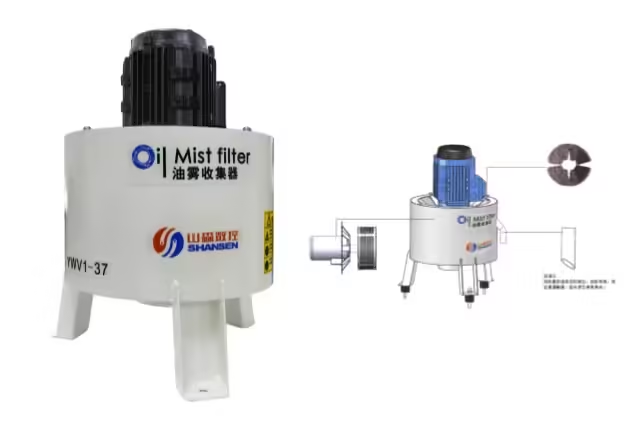
Shansen CNC manufactures oil mist collectors for CNC machine tools and industrial machining applications.
Our oil mist collector product range includes multi-stage filtration configurations using different filter materials and optional additional filtration stages.
The product design can incorporate:
- Multi-stage filtration
- Pre-filtration
- Fine filtration
- Oil drainage
- Centrifugal airflow
- Direct-drive motor
- Low-noise and low-vibration design
For selected applications, electrostatic oil mist filtration is also available, using an integrated filtration and high-voltage collection system.
OEM requirements such as dimensions, electrical specifications, installation configuration, labeling, and other machine-specific requirements can be discussed according to the project.
How to Request an Oil Mist Collector Quotation
When requesting a quotation, providing technical information in advance can help the manufacturer recommend a suitable model.
Useful information includes:
Machine Information
- Machine type
- Machine model
- Enclosure dimensions
- Spindle speed
Process Information
- Machining process
- Cutting fluid
- Oil or coolant type
- Approximate mist generation
Installation Information
- Available installation space
- Existing mounting dimensions
- Duct diameter
- Intake position
- Required airflow
Electrical Information
- Supply voltage
- Frequency
- Phase
Photographs of the machine and installation area are also useful for OEM and retrofit projects.
Frequently Asked Questions About CNC Oil Mist Collectors
What is a CNC oil mist collector?
A CNC oil mist collector is a filtration device designed to capture airborne oil mist and coolant mist generated during machining.
What machines use oil mist collectors?
Oil mist collectors are commonly used on CNC lathes, machining centers, grinding machines, milling machines, turning centers, and other machine tools.
What is the difference between an oil mist collector and a coolant filter?
An oil mist collector treats airborne mist generated during machining, while a coolant filter generally treats liquid coolant and removes solid contaminants or other particles from the coolant system.
How do I choose an oil mist collector for a CNC machine?
Consider the machine type, enclosure size, machining process, coolant or cutting oil, spindle speed, required airflow, filtration method, installation space, and maintenance requirements.
What filter materials are used in oil mist collectors?
Depending on the product design, oil mist collectors may use different filtration materials and grades, including G4, F5, F8, and other specialized filtration media.
What is an electrostatic oil mist collector?
An electrostatic oil mist collector uses an ionization and electrostatic collection field to capture fine airborne particles and droplets.
How often should an oil mist filter be replaced?
There is no universal replacement interval. Maintenance frequency depends on the machining process, mist concentration, operating hours, filter design, and actual filter condition.
Conclusion
A CNC oil mist collector is an important part of the environmental and filtration equipment used around modern machine tools.
The correct collector should be selected according to the actual machining process rather than simply the machine’s model or motor power.
Key factors include:
Machine type + Mist generation + Machining fluid + Airflow + Filtration method + Installation space + Maintenance requirements
For OEM machine builders, these factors should be considered during the machine design stage. For retrofit applications, the existing installation and operating conditions should be evaluated before selecting a replacement.
Shansen CNC provides CNC oil mist collectors, machine tool filtration equipment, and other CNC machine tool accessories for OEM, ODM, replacement, and industrial applications.