-
WhatsAPP: +86 18706448138
-
Tengzhou, Shandong, China

Innovative Electrical Solutions for CNC Machines
Innovative Electrical Solutions for CNC Machines

Precision Pulse Generator: Ultimate Guide for Engineers and Hobbyists
Explore applications, features, and buying tips for precision pulse generators. Expert guide for lab testing, electronics, and hobby projects.
Table of Contents
Introduction to High-Precision Pulse Generators
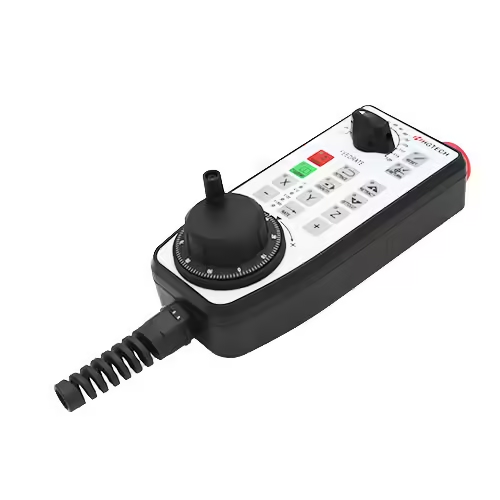
A high-precision pulse generator is an essential instrument for engineers, researchers, and hobbyists who require reliable and accurate timing signals. These devices are widely used in laboratories, electronics testing, and industrial applications. They provide reproducible pulses that simulate real-world conditions, enabling precise testing and experimentation.
Modern pulse generators offer programmable waveforms, stable frequencies, and versatile output channels, making them indispensable tools for both professional labs and advanced hobby projects.
How Pulse Generators Work
Pulse generators produce controlled electrical pulses with exact timing, amplitude, and shape. Common waveform types include square waves, rectangular pulses, and triangular signals. Timing accuracy and minimal jitter are critical for experiments, as they directly affect test results and device performance.
Programmable models allow users to set pulse width, repetition rate, and amplitude, which is particularly useful in electronics testing, semiconductor research, and signal simulation for industrial automation.
Key Features of High-Quality Pulse Generators
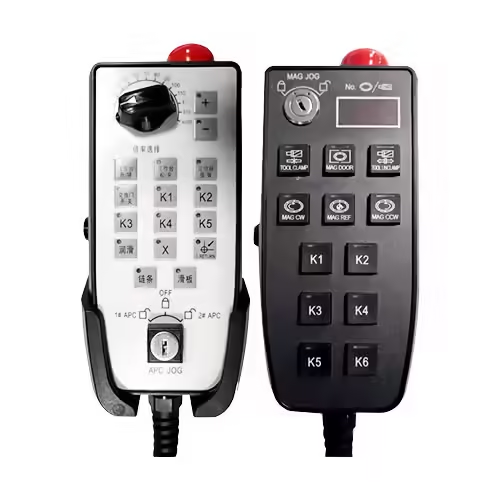
When selecting a pulse generator, engineers and hobbyists should consider the following features:
- High timing precision for accurate measurements
- Programmable waveform outputs for versatile testing
- Multiple channels for synchronized experiments
- Connectivity options such as USB, LAN, or GPIB
These features ensure consistent performance, adaptability, and seamless integration with existing lab equipment.
Applications in Electronics and Laboratory Testing
Pulse generators serve a wide range of applications:
- Circuit testing and debugging: simulating signals to verify device behavior
- Semiconductor and power device evaluation: analyzing components under controlled pulses
- Educational and research experiments: teaching signal analysis and electronics principles
- Industrial automation: generating timing signals for precise control of machinery
These use cases demonstrate the importance of selecting a generator with the right specifications for each application.
Comparing Pulse Generators and Function Generators
Although function generators are often used for general signal creation, high-precision pulse generators are designed for applications where timing accuracy is critical.
| Feature | High-Precision Pulse Generator | Function Generator |
|---|---|---|
| Timing Accuracy | Nanosecond-level | Moderate |
| Waveform Types | Pulse, Square, Triangle | Sine, Square, Triangle, Ramp |
| Repetition Rate | Very stable | Less precise |
| Use Case | Lab testing, industrial, research | General electronics testing |
| Programmability | Extensive | Limited |
Pulse generators are the preferred choice for tasks requiring precise timing and multi-channel outputs, while function generators are suitable for basic waveform generation.
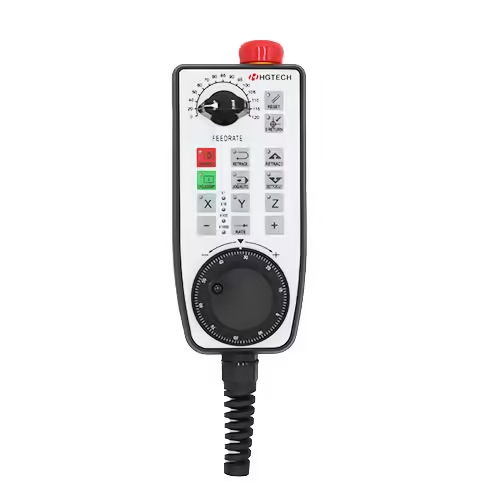
Choosing the Right Pulse Generator
Selecting the right device depends on:
- Frequency range and pulse width: ensure it meets testing requirements
- Number of channels: single or multi-channel depending on experiment complexity
- Intended use: laboratory research, industrial testing, or hobby projects
- Budget considerations: balancing features and cost
As a manufacturer, we recommend reviewing both technical specifications and practical usage scenarios to identify the ideal model.
Troubleshooting and Maintenance Tips
Proper care ensures longevity and consistent performance:
- Regular calibration to maintain precision
- Monitor signal outputs for anomalies
- Operate in a stable, temperature-controlled environment
- Follow the manufacturer’s maintenance guidelines
Routine maintenance prevents unexpected failures and preserves accuracy over time.
Buying Guide and Where to Purchase
For reliable performance, purchase from authorized manufacturers or distributors. Benefits include:
- Genuine products with full technical specifications
- Access to technical support and guidance
- Warranty and after-sales service
- Availability of latest models and updates
Choosing the right supplier ensures product authenticity and optimal performance.
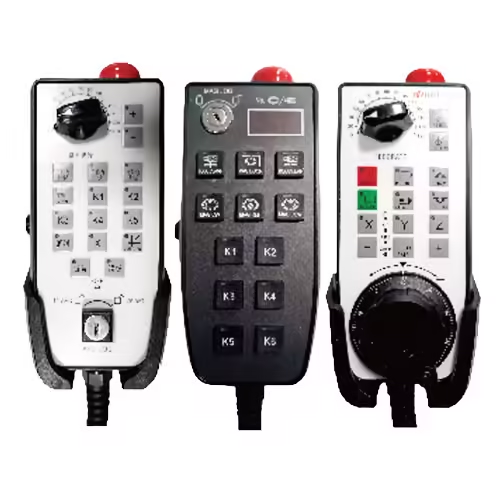
Conclusion
High-precision pulse generators are indispensable tools for engineers, researchers, and hobbyists. With accurate timing, versatile waveform outputs, and robust performance, they enable reliable testing, experimentation, and industrial applications.
As a manufacturer, we provide a range of pulse generators designed to meet diverse technical needs. Selecting the right model and maintaining it properly ensures consistent, long-term results and enhances the efficiency of your projects and experiments.
FAQ: Precision Pulse Generator
Q1: What is a precision pulse generator?
A: A precision pulse generator is a device that produces highly accurate and repeatable pulses for lab testing, electronics experiments, and industrial applications.
Q2: How does a precision pulse generator differ from a function generator?
A: Unlike function generators, precision pulse generators focus on timing accuracy, pulse width control, and multi-channel synchronization for precise testing.
Q3: What are the main applications of precision pulse generators?
A: They are commonly used for electronics testing, semiconductor evaluation, research experiments, and industrial automation.
Q4: How do I choose the right precision pulse generator for my lab?
A: Consider frequency range, pulse width, number of channels, connectivity, and your specific testing or research needs.
Q5: Can precision pulse generators be integrated with other lab equipment?
A: Yes, most models offer USB, LAN, or GPIB interfaces, allowing seamless connection to oscilloscopes, power supplies, and data acquisition systems.